.png)

Lexapro and Zoloft During Pregnancy — Is It Safe? Everything You Need to Know

Pregnancy is a time of joy and anticipation. Unfortunately, it can also be a time filled with worry — especially if you're dealing with mental health conditions like depression or anxiety.
It's valid to have concerns. You love your baby already. And you want to do everything right.

But here's what most people don't tell you — untreated depression during pregnancy is also a risk. A big one. So this isn't just about the medication like lexapro vs zoloft. This is about you, your mental health, and making the best decision for both you and your baby.
Let's break everything down — simply, clearly, and honestly.
What Is Lexapro? And Why Do People Take It During Pregnancy?
Lexapro is the brand name for escitalopram. It belongs to a group of medications called SSRIs — selective serotonin reuptake inhibitors. It is used to treat depression and anxiety. And yes — pregnancy can sometimes trigger depression, even in women who have never struggled with it before.
That is why so many pregnant women find themselves asking the same question — "Can I keep taking this?"
Is Lexapro Safe During Pregnancy?
This is the most common question. And the honest answer is — it depends on your individual situation.
The FDA classifies Lexapro as a "Pregnancy Category C" drug. Essentially, this means risk cannot be fully ruled out, and more research still needs to be done. The FDA recommends consulting your doctor before deciding whether to take Lexapro during pregnancy.
Category C does NOT mean "dangerous." It simply means we do not have enough large-scale human studies yet to say with 100% certainty.
Studies show that Lexapro does cross the placenta and can reach the baby. But the levels in the fetus are significantly lower than in the mother, which helps reduce potential risk.
Most importantly — most babies born to mothers who took SSRIs during pregnancy were born healthy and without major complications.
Can Lexapro Cause Birth Defects?
This is the fear that keeps most mothers up at night. Let's look at what the research actually says.
Some research found that when mothers took SSRIs like Lexapro during pregnancy, babies had a slightly higher risk of developing certain congenital disabilities. However, this increased risk was minimal.
Two large case-control studies did find an increased risk for some birth defects, but the absolute risk appears to be small.
Most studies show that SSRIs are not linked with birth defects. However, one SSRI called paroxetine (Paxil) might slightly raise the risk of heart defects in babies when used during the first trimester — which is why most doctors do not recommend paroxetine during pregnancy. Lexapro and Zoloft do not carry this same warning.
Risks of Taking Lexapro During Pregnancy — What You Should Know
Being informed is not the same as being scared. Here are the specific risks that have been identified.
Low Birth Weight and Preterm Birth
Some studies show that Lexapro may increase the risk of low birth weight. It also might contribute to the chance of preterm birth. These risks are considered small, and your doctor will monitor for them during regular prenatal visits.
Third Trimester Complications
Some studies show that Lexapro can cause problems with pregnancy especially into the third trimester, including respiratory problems in the newborn. This is why the timing of medication use matters a lot.
Neonates exposed to Lexapro late in the third trimester may require respiratory support, tube feeding, or prolonged hospitalization. Exposed newborns should be monitored after delivery for direct toxic effects, discontinuation syndrome, and serotonin syndrome.
Neonatal Withdrawal Symptoms
Some babies born to mothers who took Lexapro during pregnancy may experience withdrawal symptoms. Common signs include excessive crying, tremors or shaking, poor feeding habits, sleep disturbances, irritability, and jitteriness.
These symptoms usually appear within 72 hours of birth and resolve within 2 weeks. They are temporary — but your doctor needs to know so the baby can be monitored.
Persistent Pulmonary Hypertension (PPHN)
Some studies have suggested that when people take SSRIs like escitalopram during the second half of pregnancy, their babies might have a higher chance of a serious lung condition called persistent pulmonary hypertension.This is a rare condition, but it's important to know about it.
What Happens If You Stop Taking Lexapro Suddenly?
Please — do not stop your medication overnight because you found out you are pregnant. This is one of the most common and most harmful mistakes women make.
For some people, discontinuing antidepressants can lead to a relapse in depression symptoms or even suicidal thoughts. If this happens, it can put both mother and baby at risk.
If you plan to stop this medication know how to stop taking lexapro, your healthcare provider may suggest slowly lowering the dose instead of stopping all at once.
Talk to your doctor mosaic counseling first. Always. They will help you create a safe plan — whether that means continuing, tapering, or switching.
Risks of NOT Treating Depression During Pregnancy
This part is just as important as the section on medication risks.
Without treatment for depression during pregnancy, you might not seek the prenatal care you need. You might not eat the healthy foods you and your baby need. Or you may have trouble caring for yourself and your family if depression becomes overwhelming.
Having depression during pregnancy raises risks for babies comprising premature birth, low birth weight, less growth in the womb, and other problems after birth. Untreated depression during pregnancy also raises the risk of postpartum depression and trouble bonding with your baby.
That is a real risk. And it deserves to be weighed alongside the risks of medication — not ignored.
Is Zoloft Safe During Pregnancy?
Zoloft is the brand name for sertraline. It is also an SSRI — just like Lexapro. And it is one of the most studied antidepressants in the context of pregnancy.
For the most part, taking Zoloft during pregnancy is considered safe. In fact, it is trusted as one of the safest antidepressant options — but there are some potential risks to know about.
The FDA classifies Zoloft as a Pregnancy Category C drug. This means that animal studies have shown potential harm to a fetus. Still, no adequate human studies have yet been conducted — so the decision must be made carefully with your doctor. If you take this time so know how to stop taking zoloft safely.
Potential Risks of Zoloft During Pregnancy
Taking too much Zoloft during pregnancy might increase the potential risk of certain complications including preterm labor and low birth weight babies. Following your doctor's instructions when taking Zoloft during pregnancy is critical for your and your baby's health.
Can Zoloft cause birth defects?
There is some concern that SSRI use might contribute to an increased risk of respiratory distress syndrome, pulmonary hypertension, and other complications. However, most research concludes that SSRIs like Zoloft are likely not associated with severe abnormalities or malformations.
Can Zoloft cause withdrawal in my baby?
Some studies suggest that when mothers take high doses of SSRIs late into the third trimester, babies might be at increased risk for neonatal abstinence syndrome. This can cause jitteriness, irritability, difficulty sleeping, and feeding issues. Not all babies who are exposed to Zoloft in the womb will experience withdrawal.
Does Zoloft affect fertility?
There is some research suggesting that women who take SSRIs may have lower pregnancy rates. Discuss all your options with your healthcare provider if you are trying to conceive. This is something worth bringing up before you start trying, so your doctor can advise you properly.
Zoloft vs Lexapro During Pregnancy — Which Is Better?
This is a question I get very often in clinical conversations. Here's the honest answer.
Both are Category C. Both are SSRIs. Both carry similar risk profiles. But when it comes to clinical evidence and doctor preference for pregnancy, sertraline (Zoloft) tends to have a slight edge — simply because it has been studied more extensively in pregnant and breastfeeding women.
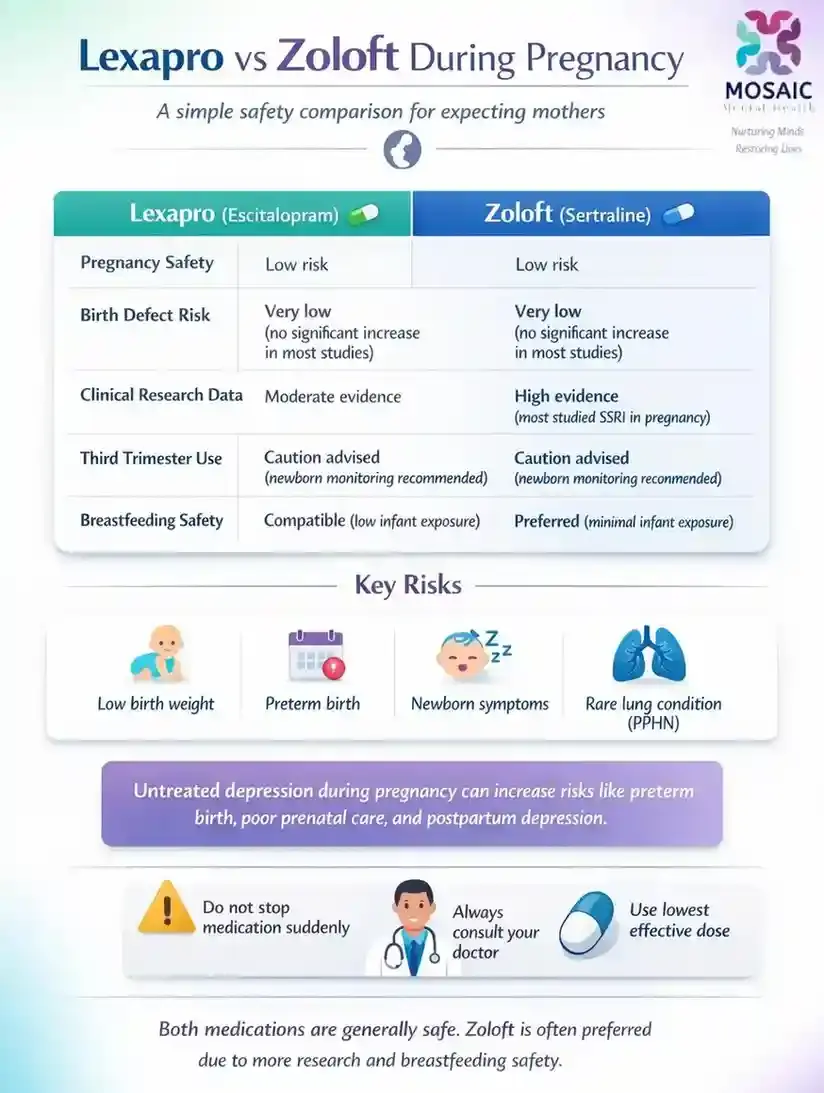
Sertraline has the most clinical evidence among all SSRIs for treating depression during the perinatal period.
That said — the best medication is the one that is already working for you. Switching medications mid-pregnancy just to use a different SSRI introduces its own risks. Your doctor will weigh this very carefully.
If you use antidepressants during pregnancy, your healthcare team tries to minimize the baby's exposure by prescribing a single medicine at the lowest effective dose — particularly during the first trimester.
Can You Take Lexapro While Breastfeeding?
Many new mothers want to breastfeed. This is a beautiful thing. And worrying about medication in your breast milk is completely normal.
A safety assessment deems the use of escitalopram as possibly compatible with breastfeeding. If you need escitalopram treatment, it is not a reason to stop nursing your baby.
However, there is an important nuance here. Among SSRIs, sertraline and paroxetine produce undetectable serum levels in more than 200 newborns studied during breastfeeding. Escitalopram, on the other hand, tends to have slightly higher levels in breast milk.
This is why many doctors prefer Zoloft over Lexapro while breastfeeding. Zoloft is considered the first-line drug for breastfeeding mothers, according to studies. Consult your doctor to make sure your dosage is appropriate if you are breastfeeding.
The bottom line — both can be used. But if you have a choice and your mental health is equally well-managed by both, sertraline may be the safer option while nursing.
What About Alternative Treatments During Pregnancy?
Medication is not the only answer. And I always like to give my patients the full picture.
Keep in mind that talk therapy can also help treat depression during pregnancy. Ask your healthcare team to refer you to a therapist skilled in cognitive behavioral therapy (CBT). Regular exercise can also ease depression — ask your healthcare provider what types of exercise are safe for you during pregnancy.

These options can be used alone or alongside medication. For mild to moderate depression, therapy may be enough. For moderate to severe depression, medication is often necessary — and the risks of going untreated are real.
Sertraline for Postpartum Depression — What You Need to Know
The baby is here. But the hard part is not always over.
Postpartum depression affects about 1 in 7 women. It is not weakness. It is a medical condition — caused by dramatic hormonal shifts that happen right after delivery.
Sertraline is one of the most well-studied medications for postpartum depression. Research published in JAMA Network Open found that women with postnatal depression who took SSRIs like sertraline had stronger relationship satisfaction and a lower risk of depression for up to five years after giving birth. Their children also showed better physical and emotional development outcomes.
It may be wise for most postpartum women to start at the equivalent of 25 mg of sertraline, as they are more likely to experience side effects at typical starting doses used in non-parturient women.
If you are struggling after delivery, please reach out. This is treatable. You do not have to power through it alone.
Zoloft for PMDD and Perimenopause Anxiety
For women who suffer from premenstrual dysphoric disorder (PMDD), SSRIs offer real relief. And the way you use them can be tailored to your cycle.
Zoloft for PMDD can be taken in two ways. Continuous daily dosing works well for severe cases. But for many women, luteal phase dosing — taking it only during the second half of the cycle — is equally effective and reduces total medication exposure.
For women navigating perimenopause anxiety, SSRIs like Lexapro and Zoloft have shown real benefit. Off-label treatment with SSRIs like Lexapro can help reduce vasomotor symptoms of menopause including hot flashes, night sweats, and skin flushing, as well as depression and sleep disturbances during this period.
A meta-analysis of SSRI trials found escitalopram was among the most effective SSRIs for reducing the daily frequency of hot flashes in perimenopausal women, with dosing recommendations of 10–20 mg per day.
Which SSRI Is Right for You? A Simple Breakdown
Lexapro | Zoloft | |
FDA Pregnancy Category | C | C |
Birth defect risk | Low | Low |
Third-trimester caution | Yes | Yes |
Breastfeeding safety | Possible, slightly higher milk levels | Preferred — lowest infant exposure |
Postpartum depression | Effective | Most studied, first-line |
PMDD | Fast-acting, effective | Effective with luteal phase dosing |
Menopause / hot flashes | Strong evidence | Less studied for this |
Perimenopause anxiety | Effective | Effective |
Should You Switch Medications During Pregnancy?
The decision to continue or change your antidepressant depends on whether your depression is under control. Concerns about risks must be weighed against the chance that a different medicine might not work, which could cause your depression to come back.
Switching is not always the right move. A medication that is working for you is valuable. Changing it introduces uncertainty — and during pregnancy, uncertainty is something we want to minimize.
A Final Word From a Doctor to You
You are not doing anything wrong by asking these questions. You are doing everything right.
The most important thing you can do is have an open, honest conversation with your OB, midwife, or psychiatrist. Bring your questions. Bring your fears. And let them help you make a decision that accounts for your full health picture — not just the medication, but your mental health, your history, and your baby's wellbeing.
It is important to discuss starting or stopping any medication with your doctor, especially if you are pregnant. Medications like Lexapro are excellent for treating depression; however, only your doctor can help you make the decision on whether or not the risks outweigh the benefits.
Your mental health matters. Your baby needs a healthy you. And with the right support, you can protect both.
Related Post - How Online Psychiatry Does Mental Health Care


Comments